


What Does the P0443 Code Mean?
P0443 — Evaporative Emission Control System Purge Control Valve Circuit Malfunction
Some scan tools may display it as:
“P0443 Evaporative Emission Control System Purge Control Valve Circuit Open”
This P0443 code means your vehicle’s computer has detected an electrical problem in the EVAP purge valve circuit.
In most cases, the issue is caused by:
- a faulty purge valve solenoid,
- damaged wiring,
- a blown fuse,
- or a bad electrical connection.
The most common fix is replacing the EVAP purge valve or repairing the wiring harness.
What Does the Purge Control Valve Actually Do?
The EVAP (Evaporative Emission Control) system prevents fuel vapors from escaping into the atmosphere.
Instead of allowing gasoline vapors to vent directly into the air, the system stores them inside a charcoal canister. When driving conditions are appropriate, the purge valve opens and allows those vapors to enter the engine intake manifold, where they are burned during combustion.
Here’s a simplified EVAP purge process:
- Fuel vapors build inside the fuel tank
- Vapors move into the charcoal canister
- The ECU commands the purge valve to open
- Vapors flow into the engine intake
- The engine burns the vapors during normal combustion
The purge valve is electronically controlled by the ECU through a solenoid circuit. If the ECU cannot properly control or monitor that circuit, it may trigger code P0443.

What Causes Code P0443?
Internal coil failure, wiring damage, and connector corrosion are the most common triggers.
1. Faulty EVAP Purge Valve Solenoid(~60% of cases — Most Common)
- No “clicking” sound when the valve is activated;
- Multimeter tests show 0Ω (short) or infinite Ω (open) resistance (standard range: 5–10Ω for most vehicles).
2. Damaged/Corroded EVAP Wiring Harness(~25% of cases)
- Heat-induced insulation cracking/melting (causes intermittent shorts to ground);
- Road salt/moisture corrosion (greenish buildup on pins) or rodent damage (chewed wires);
- Broken connector locking tabs (allows debris to seep in, creating high electrical resistance).
Even a functional purge valve fails if voltage/ground signals are interrupted.
3. Blown Dedicated Circuit Fuse or Failed Purge Relay(~10% of cases)
- The purge valve often shares a 10–15A fuse with other emissions equipment (O₂ sensor heaters, secondary air injection pumps);
- A shorted O₂ sensor wire or faulty emissions component can blow the shared fuse, cutting power to the purge valve;
- A failed purge relay (controls power to the valve) has the same effect.
Critical tip: If the fuse blows immediately after replacement, there’s a direct short to ground in the wiring harness.
4. Cracked/Leaking Vacuum Hoses(Indirect Contributor)
- Pressure imbalances from cracks, disconnections, or collapsed hoses disrupt stable valve operation;
- Long-term stress degrades the solenoid, triggering P0443 (often alongside related codes like P0441/P0455).
Always inspect hoses during troubleshooting—they’re low-cost to replace and prevent secondary failures.
5. Faulty ECM/PCM Purge Driver(Rare — <5% of cases)
- Only suspect this after ruling out all other issues (valve, wiring, fuse, hoses);
- Resetting/reprogramming the ECM often resolves the issue (replacement is rarely needed).
Common Symptoms of a P0443 Code
1. Illuminated Check Engine Light (CEL)
2. Unusual Fuel Smell
- Stagnant fuel vapors build up in the EVAP system and may leak through cracked hoses, a saturated canister, or loose gas cap.
- The odor is strongest near the rear of the vehicle (fuel tank area) or engine bay, especially after refueling or when the engine is warm.
3. Poor Fuel Economy
4. Hard Cold Starts
5. Slight Idle Instability
- Excess fuel vapors dilute the air-fuel mixture, causing rough or fluctuating idle—especially when the engine reaches operating temperature.
- In severe cases, this may lead to hesitation or brief stalling (rare, but more common in high-mileage vehicles with additional EVAP leaks).
6. Failed Emissions Test
Can You Drive With a P0443 Code?
Usually yes.
Most vehicles with a P0443 code remain drivable in short-term (1–2 weeks), especially if the issue is limited to the purge valve circuit.
However, that does not mean the issue should be ignored indefinitely.
You should repair the problem sooner if you notice:
- strong fuel smell,
- rough idle,
- hard starting,
- stalling,
- multiple EVAP codes,
- or worsening drivability.
These symptoms may indicate the purge valve is stuck open or the EVAP system is malfunctioning more severely.
Ignoring P0443 for too long may lead to:
- reduced fuel efficiency,
- failed emissions tests,
- increased hydrocarbon emissions,
- additional EVAP trouble codes,
- or catalytic converter stress in some cases.
The problem also rarely fixes itself permanently. It’s best to fix it as soon as possible.
How to Diagnose a P0443 Code Step by Step
Necessary Inspection Tools
- Digital multimeter (for resistance/voltage testing)
- Basic hand tools (screwdrivers, socket set)
- Electrical contact cleaner
- Vacuum gauge (optional, for leak verification)
- Vehicle service manual (to locate components specific to your make/model)
Step 1: Scan for Related Codes & Freeze Frame Data
- Pull P0443 and any associated EVAP codes (e.g., P0440, P0441, P0446, P0455)—multiple codes help distinguish electrical issues (P0443) from flow/leak problems (P0441/P0455).
- Review freeze frame data (engine temperature, speed, fuel level) to identify when the fault occurs (e.g., cold starts vs. highway driving), narrowing intermittent issues.
Step 2: Visual Inspection of Key Components
- Purge Valve Connector: Check for corrosion, bent pins, loose terminals, or broken locking tabs (poor contact is a top culprit). Disconnect and clean with contact cleaner if dirty.
- Wiring Harness: Inspect the wires linking the connector to the PCM—look for fraying, melting (near hot components like the exhaust manifold), or rodent damage.
- EVAP Fuse: Locate the dedicated EVAP/purge valve fuse (via fuse box diagram) and check for burns or breaks—replace if blown (immediate fuse re-blowing indicates a short circuit).
- Vacuum Hoses: Examine hoses connected to the purge valve and EVAP canister for cracks, disconnections, or collapse—damaged hoses cause mechanical stress on the valve, leading to electrical failure.
Step 3: Test Purge Valve Resistance & Electrical Supply
-
Resistance Test: Disconnect the purge valve connector, set the multimeter to ohms (Ω), and touch leads to the valve’s terminals.
- Standard range: 5–10 ohms (5–7 ohms for Ford/Chevy/Nissan/Dodge; confirm with your manual).
- Red flags: 0Ω (short circuit) or infinite Ω (open circuit)—indicates a faulty valve.
- Voltage/Ground Check: With the connector connected, turn the ignition to “ON” (engine off) and measure voltage at the valve’s power terminal (should match battery voltage, ~12V). Test ground continuity between the valve’s ground terminal and the vehicle’s chassis—no continuity means a broken ground wire.
Step 4: Purge Valve Functional Verification
- Remove the purge valve (disconnect hoses/wiring) and blow air through it—no air should pass (valve is closed when unpowered).
- Connect a 12V power source (e.g., car battery) to the valve’s terminals (red to positive, black to negative)—air should flow freely (valve opens when powered).
- Listen for a distinct “click” when power is applied—no click indicates a failed solenoid.
Step 5: Vacuum Leak Confirmation (Optional)
- Connect the gauge to the EVAP system (follow manual for access points).
- Start the engine and idle—steady vacuum (no pressure drop) confirms no leaks.
- A dropping vacuum indicates a leak in the canister, hoses, or purge valve gasket (address before re-testing electrical components).
Using an ANCEL Scanner to Diagnose P0443 Faster
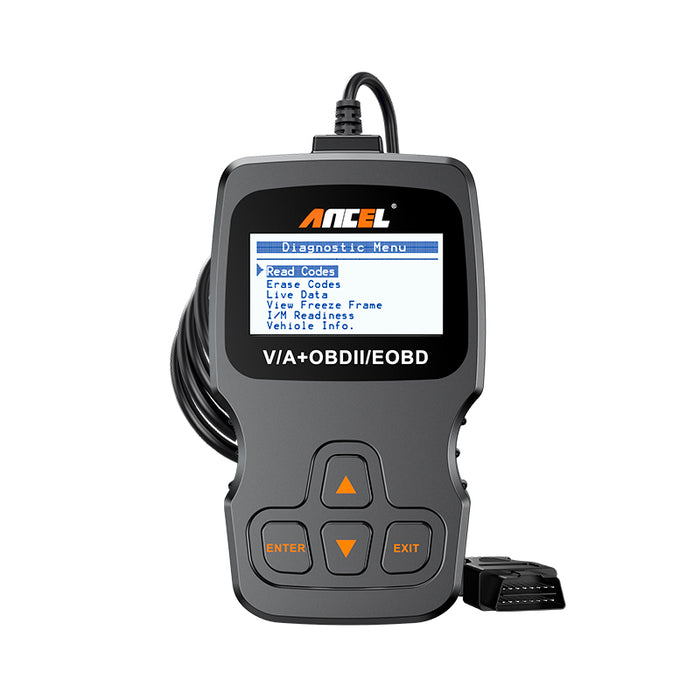
ANCEL’s line of OBD2 scanners is specifically designed to simplify EVAP system troubleshooting:
-
Full EVAP live data reading: View real-time data like purge valve duty cycle, EVAP system pressure, and PCM control signals—critical for identifying open circuits or abnormal voltage.
-
Accurate DTC interpretation: Not only reads P0443 but also provides detailed explanations of the code, including vehicle-specific causes (works for Ford, Chevy, Nissan, Dodge, and 99% of vehicles).
-
Emission readiness monitor check: After repairs, verify if the EVAP monitor is “ready” to ensure the code won’t return during emissions testing.
-
One-click code management: Read, clear, and recheck codes in seconds—no need to disconnect the battery (which resets other vehicle settings).
- Bi-directional control (premium models): Some ANCEL scanners (e.g., ANCEL FX8000) allow you to manually activate the purge valve via the scanner, eliminating the need for a 12V power source to test functionality.
Suitable ANCEL Device Recommendation
-
For basic DIYers: ANCEL AD310 (affordable, easy-to-use, reads/clears codes, checks readiness monitors).
-
For advanced troubleshooting: ANCEL FX2000 (includes live data, DTC explanations, and compatibility with all makes/models).
- For professional-level repairs: ANCEL FX8000 (bi-directional control, EVAP system tests, and detailed wiring diagrams).
All ANCEL scanners are compatible with Ford, Chevy, Nissan, Dodge, and other major brands—making them the perfect tool for diagnosing P0443 across vehicles.
Recommended ANCEL Diagnostic Tools


How to Fix Code P0443
| Fix Method | When to Use | Tools Needed | Instructions |
|---|---|---|---|
| Replace Faulty Canister Purge Valve | Resistance/functional test confirms valve failure (0Ω/infinite Ω or won’t open/close) | Socket set, screwdrivers, dielectric grease, gloves | 1. Disconnect negative battery terminal. 2. Locate valve, disconnect hoses/connector. 3. Remove fasteners, replace with OEM/quality aftermarket valve. 4. Reconnect components, apply dielectric grease to connector. 5. Reattach battery. |
| Repair/Replace Damaged EVAP Wiring | Continuity test fails (broken wires) or visual damage (fraying/melting) | Multimeter, wire cutters/strippers, heat-shrink connectors, heat gun, heat-resistant tape | 1. Trace harness to find wire break. 2. Cut damaged section, strip wire ends (1/4 inch). 3. Splice with matching-gauge automotive wire using heat-shrink connectors. 4. Seal with heat gun, wrap vulnerable areas with heat-resistant tape. 5. Retest continuity. |
| Clean Corroded Connectors & Apply Grease | Connectors are dirty, oxidized, or loose (no broken wires) | Electrical contact cleaner, small brush, compressed air, dielectric grease, zip ties | 1. Disconnect purge valve connector. 2. Spray contact cleaner, scrub corrosion with brush. 3. Dry with compressed air, apply thin dielectric grease. 4. Reconnect firmly, secure with zip ties if loose. |
| Replace Damaged Vacuum Hoses | Hoses are cracked, brittle, or leaking (or P0441/P0455 codes present) | Hose cutters, new vacuum hose (1/4” or 3/8”), zip ties/clamps | 1. Note hose routing, remove damaged sections. 2. Cut new hose to match length. 3. Install new hose, ensure tight fits on fittings. 4. Secure with zip ties/clamps, test for leaks (soapy water/vacuum gauge). |
| Reset Fuse & Recalibrate PCM | EVAP fuse is blown (no short circuit) or PCM signal is abnormal | OBD2 scanner (e.g., ANCEL), fuse puller, replacement fuse (10–15A) | 1. Locate and replace blown EVAP fuse (match amperage). 2. If fuse blows again, retest for shorts. 3. Use scanner to clear codes. 4. Complete 2–3 full driving cycles (cold start → 20–30min drive → idle → shut off). 5. Rescan to confirm PCM recalibration. |
P0443 Repair Cost & DIY Difficulty Guide
| Repair Item | DIY Repair Cost | Professional Repair Price | DIY Difficulty Rating | Estimated Time | Notes |
|---|---|---|---|---|---|
| Fuse Replacement | $5–$15 (Fuse only) | Included in "Fuse/Connector/Hose Repair" package | ★★★★★ | 10–15 minutes | The simplest fix—prioritize checking first |
| Connector Cleaning + Dielectric Grease Application | $10–$20 (Contact cleaner + dielectric grease) | Included in "Fuse/Connector/Hose Repair" package | ★★★★★ | 10–15 minutes | Requires basic tools (toothbrush, compressed air) |
| Vacuum Hose Replacement | $10–$30 (Hose + zip ties) | Included in "Fuse/Connector/Hose Repair" package | ★★★★☆ | 20–30 minutes | No special tools needed—note hose routing |
| Canister Purge Valve Replacement | $30–$150 (Aftermarket part)
|
Independent Shop: $200–$400
|
★★★☆☆ | 30–60 minutes | Requires basic hand tools (socket set, screwdrivers) |
| Wiring Repair | $10–$50 (Wire + heat-shrink connectors) | Independent Shop: $250–$450
|
★★☆☆☆ | 1–2 hours | Requires multimeter, wire strippers, heat gun |
| PCM Reprogramming | No DIY Cost (Not DIY-feasible) | Independent Shop: $300–$450
|
★☆☆☆☆ | 30–60 minutes | Requires professional equipment and manufacturer-authorized software |
| Professional Diagnosis Fee | No DIY Cost (Not applicable for DIY) | $80–$150 (Typically waived if repairs are performed at the shop) | - | 20–30 minutes | Includes code reading and fault localization service |
Brand-Specific P0443 Problems
P0443 Code Ford (Including Ford Explorer)
- Wiring harness damage: The purge valve wiring near the exhaust manifold is often exposed to high heat, leading to fraying or melting.
- Faulty purge valve location: On Ford Explorer models (2000–2010), the purge valve is mounted under the battery tray, making it vulnerable to corrosion from battery acid leaks.
- Common fix: Inspect the wiring for heat damage, clean or replace corroded connectors, and use heat-resistant tape to protect vulnerable wires. For Explorer models, check the battery tray for leaks before replacing the valve.
P0443 Code Chevy / Chevrolet
- TIPM (Totally Integrated Power Module) issues: The TIPM (a fuse/relay box) can fail to supply power to the purge valve circuit.
- Loose connectors: The purge valve connector on Chevy trucks is often prone to vibration-induced loosening.
- Common fix: Test the TIPM for proper voltage output, secure loose connectors with zip ties, and replace the purge valve if resistance tests fail (Chevy’s standard resistance range is 5–7 ohms).
P0443 Code Nissan
- Purge valve solenoid failure: Nissan’s purge valves are known for internal solenoid burnout, especially in high-mileage vehicles (100k+ miles).
- Vacuum hose cracks: The small vacuum hoses connected to the purge valve often dry out and crack, leading to mechanical stress on the valve.
- Common fix: Replace the purge valve (OEM part number 14935-EN200 for most models) and inspect all vacuum hoses for cracks. For Nissan DTC P0443, ensure the valve’s electrical connector is fully seated—corrosion is rare but possible.
P0443 Code Dodge
- EGR/EVAP relay failure: The relay controlling the purge valve circuit can fail, cutting power to the valve.
- Wiring corrosion: Dodge’s purge valve wiring is sometimes routed near the frame, making it vulnerable to water and road salt corrosion.
- Common fix: Test the EVAP relay (located in the engine bay fuse box) for continuity, repair corroded wiring with heat-shrink connectors, and replace the purge valve if necessary (Dodge’s standard resistance range is 6–9 ohms).
P0443 vs P0441: What’s the Difference?
P0443 and P0441 both involve the EVAP purge system. However, the root causes are very different.
| Code | Meaning | Main Issue |
|---|---|---|
| P0443 | Purge Control Valve Circuit Malfunction | Electrical circuit problem |
| P0441 | Incorrect Purge Flow | Vapor flow problem |
P0443 usually points toward:
- wiring,
- solenoid,
- fuse,
- relay,
- or electrical failure.
P0441 more commonly relates to:
- vacuum leaks,
- stuck valves,
- clogged hoses,
- or incorrect vapor flow.
Although the two codes can appear together, their diagnostic paths are not identical.
FAQ:
Can a bad purge valve cause rough idle?
Yes, a faulty EVAP purge valve can absolutely cause rough idle—the severity depends on how the valve fails, with stuck-open valves being the primary culprit:
- Valve Stuck Open (Most Common Cause): A stuck-open valve allows unrestricted fuel vapors to constantly flood the intake manifold. This severely dilutes the air-fuel mixture, causing fluctuating RPMs, severe engine shaking, or even stalling at red lights.
- Valve Failed Closed (Rare Indirect Cause): A valve that cannot open (fails closed) rarely causes immediate rough idle—since no extra vapors disrupt the air-fuel mixture. However, long-term pressure buildup in the EVAP system can stress other components (e.g., EVAP canister, vacuum hoses), leading to indirect drivability issues over time.
3 Key Symptoms to Confirm It:
- Rough Idle Right After Refueling: If your car stumbles or struggles to start only after you fill up at the gas station, the purge valve is almost certainly stuck open.
- Secondary EVAP Codes: The issue will usually be accompanied by trouble codes like P0441 (Incorrect Purge Flow) or P0455 (Large Leak Detected).
- Abnormal Fuel Trims: Using an ANCEL scanner to check Live Data, you will see highly negative fuel trims, confirming the computer is trying to cut back fuel because the engine is running way too rich from the unmetered vapors.
Can a bad vacuum hose cause a P0443?
No. This is a very common point of confusion.
P0443 is strictly an electrical circuit code. The computer triggers it because it detects a short circuit, a broken wire, or a dead internal electronic coil inside the valve itself.
A cracked, leaking, or disconnected vacuum hose will cause a flow code (like P0441 or P0455), but it cannot trigger an electrical circuit code like P0443. If you have P0443, look at the wires and the plug, not the rubber hoses.
Can I replace a canister purge valve myself?
Yes, this is one of the easiest DIY fixes on a car.
- Where is it? On most vehicles, the purge valve sits right on top of the engine intake manifold, completely exposed and easy to reach.
-
How long does it take? It usually takes less than 15 minutes using basic hand tools (pliers and a socket wrench). You simply unplug the electrical connector, squeeze the clamps to remove the two vacuum lines, unbolt the old valve, and pop the new one in.
Note: A replacement part typically costs between $20 and $60.
Will P0443 clear itself?
Generally, no.
Because P0443 indicates an active electrical failure (like a melted wire or a burned-out solenoid coil), the code will remain as long as the hard electrical fault exists.
Even if you replace the broken valve, the Check Engine Light will usually stay on for several driving cycles until the computer runs its self-test.
To save time, you should use an OBD2 scanner (like an ANCEL AD410) to manually clear the code and reset the light immediately after completing the repair.
How do you fix EVAP incorrect purge flow related issues?
How do you fix EVAP incorrect purge flow related issues?
"Incorrect Purge Flow" (usually code P0441) means the electrical circuit works, but the actual volume of air moving through the system is wrong. Fix it using this 3-step checklist:
-
Check for a Stuck Valve: Remove the purge valve and try to blow air through it with your mouth. If air passes through while the valve is unplugged, it is stuck open. Replace it.
-
Inspect the Vacuum Lines: Look for cracked, brittle, or disconnected rubber hoses running from the fuel tank canister up to the engine. Squeeze them to check for soft spots or hidden tears.
-
Verify with Data: Plug in a diagnostic scanner and monitor the Live Data for Fuel Trims. If your long-term fuel trims
Can a P0443 code still appear even if the vacuum lines look fine?
Yes. P0443 is usually related to the purge control valve circuit itself, not just vacuum leaks. Even if the EVAP hoses appear intact, the problem may still come from:
- a faulty purge valve solenoid,
- damaged wiring,
- a bad relay,
- poor ground connection,
- or even a failed PCM in rare cases.
Many drivers mistakenly replace the vent valve first, even though the purge valve and vent valve are separate components on different circuits.
How can I test a purge valve myself before replacing it?
A basic DIY test involves:
- Removing the purge valve
- Trying to blow air through it without power (it should stay closed)
- Applying 12V power to see if it opens
- Measuring resistance across the terminals with a multimeter
If the valve does not click open, has abnormal resistance, or cannot hold vacuum properly, it may be defective.
Advanced diagnosis may also require a scan tool capable of activating the EVAP purge circuit.
Can I drive with a P0443 code if the car runs normally?
Usually yes — many vehicles with a P0443 code still drive normally and only show a Check Engine Light. However, ignoring the issue for too long can:
- reduce fuel efficiency,
- prevent the EVAP monitor from completing,
- cause emissions test failure,
- or eventually lead to additional EVAP-related trouble codes.
If the vehicle has rough idle, fuel smell, or hard starting, the issue should be repaired sooner.
My car runs smoothly with only check engine light on after P0443 repair, how to clear the code permanently?
After finishing all circuit and component repairs, erase trouble codes first, then complete several complete driving cycles to finish EVAP system self-test.
Only when EVAP readiness monitor passes will the code no longer pop up again.
I have replaced the EVAP vent solenoid but still get P0443, what is the most overlooked fault?
P0443 targets purge valve circuit instead of vent valve.
The most easily ignored issues are faulty EVAP relay, abnormal purge solenoid internal resistance and hidden circuit open faults, simply replacing vent valve cannot fix this code.


