


A malfunctioning mass airflow (MAF) sensor can cause poor performance, poor fuel efficiency, and sudden check engine lights. In this guide, we will explore the most reliable methods to test whether your MAF sensor is faulty.
ANCEL provides user-friendly diagnostic tools trusted by mechanics to accurately pinpoint MAF sensor issues and keep your engine running smoothly.
How a Mass Air Flow Sensor Works
Mounted in the intake air duct between the air filter housing and the throttle body, the MAF sensor continuously monitors engine air intake.
- Hot-Wire Heating: Most modern vehicles use a hot-wire MAF sensor. The Engine Control Unit (ECU) supplies current to heat an internal platinum wire to a constant temperature.
- Airflow Cooling: As intake air passes over the heated wire, it cools the wire down.
- Current Compensation: The sensor automatically increases electrical current to offset this cooling and maintain its set temperature.
- Fuel Adjustment: The ECU measures this current variation to calculate the exact mass of incoming air, dynamically adjusting fuel injection to maintain the ideal 14.7:1 air-fuel ratio.
Symptoms of a Bad Mass Airflow Sensor
Several symptoms can indicate a faulty MAF sensor.
Check Engine Light
One of the most common indicators of a bad MAF sensor is the check engine light.
When the MAF sensor sends incorrect data to the ECU, it triggers the check engine light.
Although this light can indicate various issues, it's essential to diagnose the specific cause using an OBD2 scanner.
Reduced Gas Mileage
A malfunctioning MAF sensor can cause your engine to consume more fuel than necessary.
If you notice a significant decrease in your vehicle's gas mileage, it could be due to a faulty MAF sensor sending incorrect air intake readings to the ECU.
Rough Idling and Stalling
A bad MAF sensor can cause rough idling and engine stalling. This happens because the incorrect air-fuel mixture leads to improper combustion.
If your engine struggles to maintain a steady idle or stalls frequently, the MAF sensor might be the culprit.
Hesitation and Jerking During Acceleration
When the MAF sensor fails, it can cause hesitation or jerking during acceleration.
This occurs because the engine isn't receiving the correct amount of fuel needed for smooth acceleration, resulting in intermittent power delivery.
Black Smoke from the Exhaust
A faulty MAF sensor can lead to a rich fuel mixture, causing excess fuel to burn incompletely.
This incomplete combustion can produce black smoke from the exhaust, indicating an issue with the air-fuel ratio.
Engine Misfires
Engine misfires occur when one or more cylinders fail to burn the fuel properly.
This can be caused by an improper air-fuel mixture due to a faulty MAF sensor, leading to uneven combustion and misfires.
Gas Smell from Exhaust
A strong smell of gasoline from the exhaust can indicate that too much fuel is being sent to the engine, a symptom often caused by a bad MAF sensor.
This rich mixture not only wastes fuel but can also damage the catalytic converter.
Related Reading: Boost Horsepower: Ecu Remapping For Performance

Dirty MAF Sensor vs. Failed MAF Sensor
A dirty MAF sensor can cause many of the same symptoms as a failed sensor, including rough idle, hesitation, poor fuel economy, and incorrect airflow readings.
However, a contaminated sensor may return to normal after cleaning, while an electrically failed or damaged sensor usually continues to produce fixed, missing, or erratic readings.
What Causes a MAF Sensor to Fail?
A MAF sensor may fail because of:
- Dirt, dust, or oil contamination on the sensing element.
- A clogged or damaged air filter.
- Wiring damage, corrosion, or loose electrical connectors.
- Vacuum leaks or intake air leaks affecting airflow measurements.
- Normal wear after years of operation.
Problems That Can Mimic a Bad MAF Sensor
| Possible Problem | Similar Symptoms | How to Distinguish It |
|---|---|---|
| Intake or vacuum leak | Rough idle, lean codes, hesitation | Check fuel trims and inspect for air leaks |
| Dirty throttle body | Unstable idle, stalling | Inspect and clean the throttle body |
| Faulty oxygen sensor | Poor fuel economy, rich or lean mixture | Compare O2 sensor and fuel-trim data |
| Wiring or connector damage | Intermittent readings, MAF circuit codes | Inspect terminals and test power, ground, and signal |
| Fuel delivery problem | Hesitation, misfires, lean condition | Test fuel pressure and injector operation |
Not Every Symptom Means a Bad MAF Sensor
Although these symptoms are commonly associated with a faulty MAF sensor, they are not unique to the sensor itself.
Similar problems can also be caused by intake air leaks, vacuum leaks, dirty throttle bodies, damaged wiring, faulty oxygen sensors, or other engine management issues.
Before replacing the MAF sensor, confirm the diagnosis using live MAF data, OBD2 trouble codes, and additional testing methods described below.
How to Diagnose a Bad MAF Sensor
If you're unsure where to start, follow this step-by-step workflow to diagnose a bad MAF sensor before replacing it.
How to test if a MAF sensor is bad:
- Inspect the sensor and intake system.
- Scan for MAF-related trouble codes.
- Check live MAF data.
- Verify airflow response.
- Test power, ground and signal.
- Clean the sensor and retest.
- Replace only after confirming the fault.

How to Diagnose a Bad MAF Sensor
Methods to Check if the Mass Airflow Sensor is Bad
Now that we've identified the symptoms of a bad MAF sensor, let's delve into the methods to diagnose the issue.
1. Visual Inspection
Locate the MAF sensor in your vehicle's engine bay—typically near the air filter housing.
Check for any visible damage, such as cracks, loose connections, or debris buildup on the sensor.
Ensure that all electrical connectors are secure and free from corrosion.
2. Test the MAF Sensor with an OBD2 Scanner
Car scanner is an invaluable tool for diagnosing a bad MAF sensor.
Connect the scanner to your vehicle's diagnostic port and retrieve the error codes.
Look for codes related to the MAF sensor, such as P0100, P0101, P0102, P0103, and P0104.
Besides MAF-related codes, an OBD2 scanner can also help identify related emissions issues, such as P2002 (Diesel Particulate Filter Efficiency Below Threshold) in some diesel vehicles, which may require checking the overall air and exhaust systems.
These codes indicate issues with the MAF sensor circuit, low input, high input, or intermittent problems.
Explanation of Error Codes:
-
P0100: Mass or Volume Air Flow "A" Circuit Malfunction
Indicates a general malfunction in the MAF sensor circuit.This can be caused by a faulty sensor, wiring issues, or a defective ECU. -
P0101: Mass or Volume Air Flow "A" Circuit Range/Performance Problem
The sensor readings are outside the expected range. Possible causes include a dirty or faulty MAF sensor, air leaks in the intake system, or a problem with the sensor’s electrical circuit. -
P0102: Mass or Volume Air Flow "A" Circuit Low Input
The sensor is reporting an abnormally low air flow reading. Causes might include a dirty or damaged sensor, issues with the wiring or connections, or an air leak downstream of the MAF sensor. -
P0103: Mass or Volume Air Flow "A" Circuit High Input
Triggered when the sensor reports a higher-than-expected air flow reading. Potential causes include a faulty MAF sensor, a short circuit in the sensor’s wiring, or a problem with the ECU. -
P0104: Mass or Volume Air Flow "A" Circuit Intermittent
Indicates an intermittent issue with the MAF sensor circuit. It could be due to loose or corroded connections, a failing MAF sensor, or intermittent wiring issues.
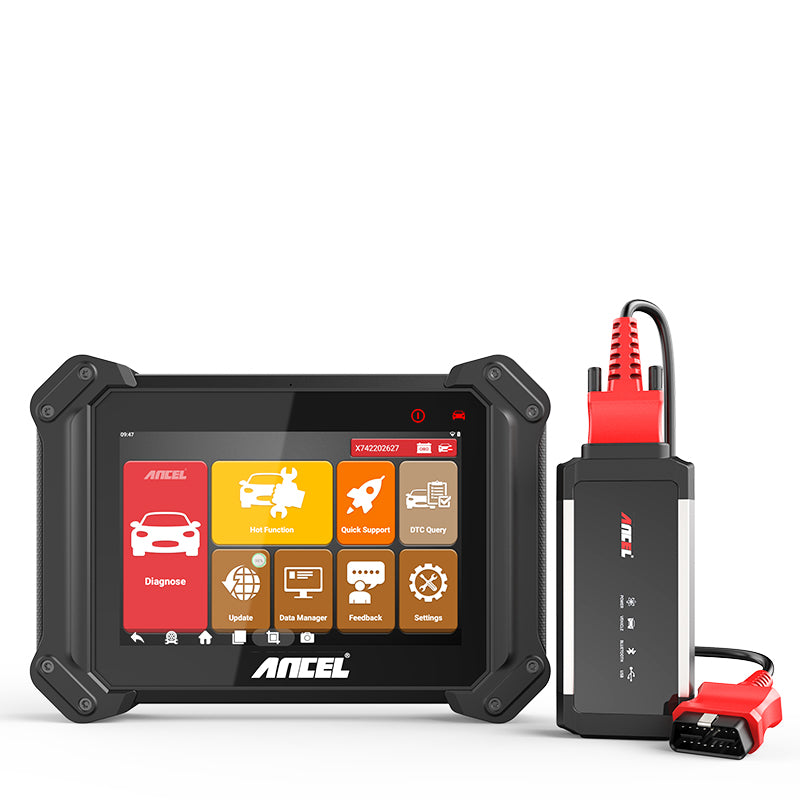
$439.99
3. Check MAF Sensor Readings
To further diagnose the MAF sensor, use the OBD2 scanner to monitor the sensor readings in real-time.
Compare the readings with the manufacturer's specifications.
A significant deviation from the normal range indicates a faulty sensor. Typically, at idle, the MAF sensor should read between 2-7 grams per second (g/s) for most vehicles.
During acceleration, the readings should increase proportionally.
A quick snap-throttle test can also help verify sensor performance. During a rapid throttle opening, the MAF reading should respond immediately and increase smoothly without hesitation or sudden dropouts.
The exact reading varies depending on engine displacement. Typical MAF Sensor Readings by Engine Size:
- 4-Cylinder (1.5L–2.0L): ~1.5 to 2.5 g/s
- V6 (3.0L–3.6L): ~3.0 to 4.5 g/s
- V8 (5.0L+): ~5.0 to 7.0+ g/s
A healthy MAF sensor should produce stable readings at idle and increase smoothly as engine speed rises. Sudden spikes, dropouts, or values that remain fixed may indicate a faulty sensor, wiring issue, or intake leak.
Live MAF data is generally more reliable than fault codes alone because it shows how the sensor performs under actual engine operating conditions.
4. Test with a Multimeter
A multimeter can also be used to test the MAF sensor. Disconnect the sensor's electrical connector and measure the resistance across the sensor terminals.
Refer to your vehicle's service manual for the correct resistance values.
Additionally, you can measure the voltage output of the MAF sensor while the engine is running.
Again, compare these readings with the manufacturer's specifications to determine if the sensor is functioning correctly.
For a more accurate test, back-probe the connector while the sensor remains plugged into the wiring harness.
- - Power supply: Verify that the sensor receives battery voltage (approximately 12V) or a 5V reference, depending on the vehicle design.
- - Ground circuit: Check that the ground connection is stable with minimal voltage drop (typically less than 0.1V).
- - Signal output: On analog MAF sensors, the signal voltage is typically around 0.5–1.0V at warm idle and should increase smoothly toward 4.0–4.5V as engine speed rises. Sudden spikes, dropouts, or a signal that remains fixed may indicate a faulty sensor or wiring problem.
Because connector pin assignments vary by manufacturer, always refer to the vehicle's service manual before testing.
Note: Do not pierce the wire insulation with the multimeter probe, as this may damage the wiring and allow moisture to enter. Use proper back-probing pins whenever possible.
5. Clean the MAF Sensor
Sometimes, a dirty MAF sensor can cause similar symptoms to a faulty one. Cleaning the MAF sensor can restore its functionality.
Use a specialized MAF sensor cleaner spray to gently clean the sensor element.
Avoid using harsh chemicals or physically touching the sensor( such as brake cleaner or carburetor cleaner), as this can damage it.
After cleaning, reinstall the sensor and test its performance.
6. Replace the MAF Sensor
If the above methods confirm that the MAF sensor is faulty, the only solution is to replace the sensor.
Purchase a high-quality replacement sensor that matches your vehicle's specifications.
Follow the manufacturer's instructions for installation, ensuring that all connections are secure and the sensor is properly seated.
7. Perform a Driving Cycle
After replacing or cleaning the MAF sensor, perform a driving cycle to allow the ECU to recalibrate.
This involves driving the vehicle under various conditions, including idling, acceleration, and steady cruising, to ensure the sensor is functioning correctly.
Preventive Measures
To avoid future issues with your MAF sensor, it's essential to adopt preventive measures.
Regularly inspect and clean the air filter to ensure that no debris enters the MAF sensor.
Periodic maintenance of the fuel injection system and timely replacement of worn-out components can also contribute to the longevity of the MAF sensor.
Best ANCEL OBD2 Scanner for MAF Sensor Diagnosis
While a visual inspection or multimeter test can help identify some MAF sensor problems, an OBD2 scanner with live data is the fastest and most reliable way to confirm a faulty sensor.
It allows you to monitor airflow readings in real time, compare them with expected values, check related fault codes, and verify repairs after cleaning or replacement.
The following ANCEL diagnostic tools are suitable for different users and budgets:
| Product | Best For | Best Match | Why It's Suitable for MAF Diagnosis |
|---|---|---|---|
| ANCEL V6 PRO+ | Professional technicians & advanced DIYers | ⭐⭐⭐⭐⭐ | • Read & clear P0100–P0104 DTCs • View live MAF airflow (g/s) • Monitor fuel trims, O2 sensors & engine load • Graph live data for easier analysis • Verify repairs after cleaning or replacement |
| ANCEL DS600 BT | Advanced DIY users & repair shops | ⭐⭐⭐⭐☆ | • Full-system diagnostics • Wireless live data streaming • Read & clear engine fault codes • Monitor MAF and related engine parameters |
| ANCEL AD410 | Beginners & basic OBD2 diagnostics | ⭐⭐☆☆☆ | • Read & clear engine DTCs • View basic live data • Check MAF-related fault codes • Entry-level solution for basic diagnosis |
Editor's Recommendation:
- For the most accurate MAF sensor diagnosis, a scanner capable of displaying live airflow data, fuel trims, and related engine parameters is recommended.
- Among the options above, the ANCEL V6 PRO+ offers the most comprehensive diagnostic capability, while the DS600 BT provides an excellent balance of features, wireless convenience, and value for most users.

ANCEL V6 PRO+
✔ Full-System Diagnostics
✔ Live Data Graphing
✔ Fuel Trim & Sensor Monitoring


Conclusion
Diagnosing a bad mass airflow sensor involves recognizing the symptoms, performing visual inspections, using diagnostic tools, and, if necessary, replacing the sensor.
ANCEL offers a range of high-quality diagnostic tools trusted by automotive professionals.
With their precision and ease of use, ANCEL tools ensure reliable performance, making them the preferred choice for mechanics seeking accuracy in vehicle diagnostics.
FAQs
What is the normal range of readings for a MAF sensor at idle?
Typically, the MAF sensor should read between 2-7 grams per second (g/s) at idle for most vehicles.
How does a dirty air filter affect the MAF sensor?
A dirty air filter can restrict airflow, leading to incorrect readings from the MAF sensor and causing engine performance issues.
What does a rich fuel mixture indicate?
A rich fuel mixture, often indicated by black smoke from the exhaust, means too much fuel is being burned, which can be caused by a faulty MAF sensor.
Can You Test a MAF Sensor by Unplugging It?
Yes. Some older vehicles may continue running using a default airflow value when the MAF sensor is unplugged.
However, this behavior varies by manufacturer and is not a reliable diagnostic method for modern vehicles.
A scan tool that displays live airflow data provides a much more accurate diagnosis.
Can a Dirty Air Filter Affect the MAF Sensor?
Yes, significantly. A restricted or damaged air filter affects the MAF sensor in two main ways:
- Direct Contamination: Dirt, dust, and oil particles bypass a worn filter and coat the sensor's sensitive hot wire, causing it to send inaccurate (falsely low) airflow signals to the ECU.
- Airflow Turbulence: A clogged air filter restricts intake airflow and creates erratic turbulence, leading to unstable sensor readings, hesitations, and reduced fuel efficiency.
What Does a Rich Fuel Mixture Mean?
A rich fuel mixture means the engine is burning too much fuel and not enough air (an air-fuel ratio lower than the optimal 14.7:1).
- Common MAF Cause: If a failing MAF sensor falsely reports higher airflow than actual, the ECU over-injects fuel.
- Key Symptoms: Black exhaust smoke, strong gasoline odors from the tailpipe, poor fuel economy, fouling spark plugs, and fault codes like P0172 (System Too Rich).
How Do You Test a MAF Sensor with an OBD2 Scanner? ⭐
You can test a MAF sensor by plugging in an OBD2 scan tool, opening the Live Data menu, and monitoring the MAF (g/s) parameter stream.
The 2-Step Test Method:
-
Idle Baseline Check: At warm idle, confirm the reading is stable and falls within the 2–7 g/s range for your engine size.
-
Snap Throttle Test: Rapidly press and release the accelerator pedal. A healthy MAF sensor should spike immediately and smoothly in proportion to engine RPM without lagging, dropping to zero, or fluctuating erratically.
Can You Test a MAF Sensor Without a Multimeter?
Yes, absolutely. You can thoroughly test a MAF sensor without a multimeter by using an OBD2 diagnostic scan tool:
- Code Scanning: Read active or pending Diagnostic Trouble Codes (DTCs) such as P0100 through P0104.
- Live Data Stream Monitoring: View real-time grams-per-second (g/s) airflow values to verify normal baseline range and throttle responsiveness.
- Visual Inspection & Cleaning: Remove the sensor to inspect the internal wire for debris/oil buildup, spray it with dedicated MAF cleaner, and check if performance recovers.
While a multimeter is useful for testing the sensor's power, ground, and signal circuits, many MAF sensor problems can be identified without one.
Can You Test a MAF Sensor Without Disconnecting It?
Yes, and back-probing without disconnecting is actually the preferred professional method.
- Scan Tool Testing: An OBD2 scanner reads data directly through the vehicle's diagnostic port while the sensor remains fully connected and operational.
- Multimeter Back-Probing: Leave the electrical harness plugged into the MAF sensor. Insert thin back-probing pins through the back of the weather-seal connector to touch the terminals:
Signal Wire: Should output ~0.5V to 1.0V at warm idle and ramp up smoothly to 4.0V–4.5V at Wide Open Throttle (WOT).
Power & Ground: Confirm full battery voltage (~12V / 5V ref) and a solid chassis ground (less than 0.1V drop).
Can You Clean a MAF Sensor Instead of Replacing It?
Yes. If the sensor is contaminated by dirt or oil, cleaning it with a dedicated MAF sensor cleaner may restore normal operation.
However, if the sensor is electrically damaged or continues to produce abnormal readings after cleaning, replacement is usually required.


