


Some repairs don’t fail because you lack parts. They fail because the car needs a scanning tool step. The ANCEL DS300 is built for those moments: full-system diagnostics, service routines, and bidirectional-style testing on supported vehicles. If your goal is basic OBD2 code reading and clearing, a simpler reader might be the smarter purchase.
DS300 at a glance
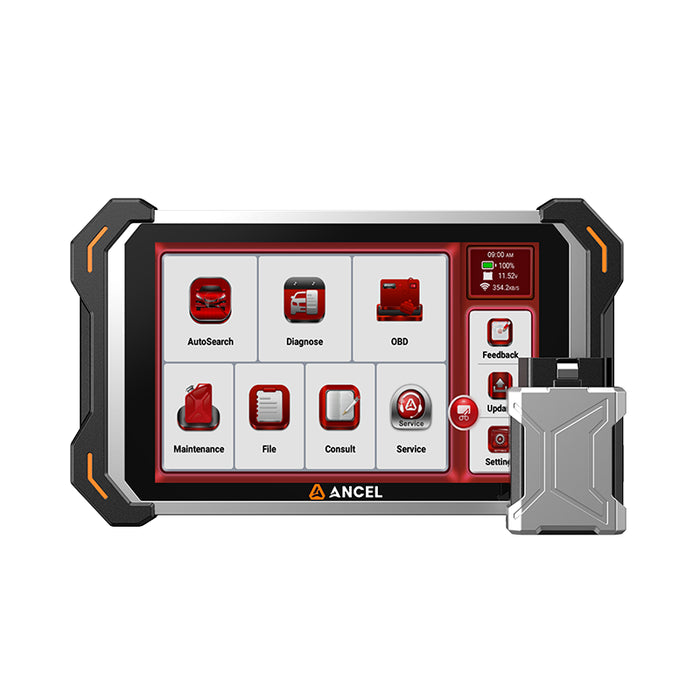
The ANCEL DS300 is a 7-inch Android-based tablet scan tool that connects through a VCI interface and is positioned for post-1996 OBD2 vehicles.
|
Item |
What it means for real use |
|
7-inch touchscreen + physical buttons |
Easier navigation and easier-to-read live data |
|
Android OS (Android 8.1 is listed by ANCEL) |
Tablet-style workflow instead of a tiny reader screen |
|
VCI box connection |
More flexible positioning near the vehicle |
|
Wireless VCI or USB connection (as listed by ANCEL) |
You can work with fewer cable restrictions, or go with lined USB when needed |
|
Built-in battery |
More practical for mobile use and multi-vehicle work |
|
OBDII & EOBD support after 1996 |
Covers standard OBD2 use cases on most modern vehicles |
Want a quick visual walkthrough of the ANCEL DS300? Watch this short demo —perfect for getting a feel for the tool before diving into details.
Who DS300 is suitable for, and who it is not
DS300 fits best when maintenance and diagnostics overlap. That usually means resets, relearns, and verification tests, not only reading codes.
DS300 is a strong fit if your work looks like this
- You scan more than the engine ECU, including ABS, SRS, transmission, and body systems.
- You want bidirectional-style testing to verify whether components respond correctly, where supported.
- You do service work that often requires scan-tool procedures, like EPB service mode, ABS bleed routines, throttle matching, battery registration, or DPF routines.
- You want a tablet workflow with saved scans, reports, and vehicle history.
- You want coding capability, and you are willing to confirm coverage before relying on it.
DS300 is not a smart buy if your needs are basic
- You mainly read and clear engine codes.
- You only want readiness checks and simple live data.
- You want the cheapest way to turn off a check engine light.
Decision table: “Should I buy DS300?”
The table below helps match DS300 to common buyer goals.
|
Your main goal |
DS300 match |
Why |
|
Clear engine codes and move on |
Low |
You will pay for features you won’t use |
|
Handle modern maintenance procedures correctly |
High |
Service routines are a main reason to buy this class |
|
Diagnose faults using verification tests |
High |
Bidirectional-style testing can reduce guessing |
|
Do coding across all brands like a dealer tool |
Medium to low |
Coding exists, but coverage is not universal |
|
Work on FCA Secure Gateway vehicles regularly |
Medium |
Works with AutoAuth |
What DS300 can do well
Full-system scanning is the baseline advantage
Full-system scanning matters because many faults sit outside the engine ECU. ABS, airbags, transmission, and body modules are common examples.
Full-system tools also make documentation easier. That helps when you want “before and after” proof or a clean scan history.
Bidirectional control and active testing are the real upgrade
Bidirectional capability matters when the goal is verification, not only reading codes.
A basic auto code reader reports faults. A bidirectional scanner can sometimes command a component or function and let you observe the response. That can reduce guessing and unnecessary parts replacement.
The ANCEL DS300 is a bidirectional diagnostic scanner that supports active testing.
However, in real-world use, the availability of actuation tests depends on the vehicle, control module, and model year, meaning some functions may not be accessible on certain vehicles.

ECU coding is included, but it should be treated as vehicle-dependent
ECU coding can be valuable after certain repairs and module replacements. It can also be misunderstood.
Coding support varies by:
- vehicle brand
- module type
- model year
- job type
The safest expectation is “confirm for this VIN and this module,” not “guaranteed dealer-level programming.”
28+ service functions are the repeat-value feature
Service functions are where most owners feel the value.
If your work includes EPB routines, ABS bleeding, throttle matching, battery registration, injector coding, DPF regeneration, steering angle resets, or similar procedures, DS300 is built for that style of work.
Service coverage is still vehicle-dependent. A listed function does not guarantee availability on every model year and trim.
Coverage and update policy
board Compatibility
The ANCEL DS300 supports a wide range of vehicles, including over 150 major brands and tens of thousands of model-year configurations. However, active tests, service resets, and advanced functions are not universally available across all vehicles.
Even when a vehicle is supported at the system level, certain actuation tests or reset routines may be unavailable depending on the specific module, ECU implementation, and model year.
Updates affect future coverage, not basic usability
Updates usually matter for two reasons: newer vehicle coverage and bug fixes.
A tool can remain usable without updates, but it may not gain support for newer models or new functions over time.
DS300 supports lifetime free updates, but also notes that after the free update period, the tool remains usable without access to newer models, functions, and some bug fixes.
The safest expectation is long-term usability, while update access mainly affects future vehicle coverage and added functions.
DS300 limitations you should understand before buying
DS300 has practical boundaries that affect compatibility, cost, and expectations.
|
Limitation |
What it affects |
What to do before buying |
|
Advanced functions vary by vehicle |
Active tests, coding, and some service routines may be missing |
Confirm your exact make, model, year, and required functions |
|
FCA Secure Gateway access may require a paid step |
Some FCA functions can be blocked without authorization |
Budget for AutoAuth if you service FCA SGW vehicles |
|
CAN FD support depends on the hardware version and VCI configuration |
Newer vehicles may require CAN FD communication |
Buyers should confirm CAN FD compatibility for their specific unit before purchase if their vehicles rely on CAN FD communication. |
|
Update policy wording is not perfectly clear |
Buyers may assume every unit has identical update terms |
Verify entitlement after activation and keep proof of purchase |
How DS300 helps, and where limits show
The scenarios below are common jobs that reveal where DS300 helps and where coverage limits show up.
Rear brakes on a vehicle with EPB
A rear brake job can stall when an electronic parking brake prevents normal caliper retraction.
How DS300 can help
- Enter EPB or brake service routines where supported.
- Put the system into service mode.
- Exit service mode and confirm the system returns to normal.
Where limits show
EPB routines vary by model and year. Function availability should be confirmed before starting the job.
Spongy brake pedal after hydraulic work, ABS bleed required
A pedal that will not firm up after normal bleeding can point to air trapped in the ABS module.
How DS300 can help
- Run an ABS bleed-style routine where supported.
- Follow prompts and then finish conventional bleeding.
- Re-scan to confirm system status.
Where limits show
Some vehicles require strict conditions to run ABS routines. Newer platforms may require CAN FD support.
Cooling fan issue, and you need proof before replacing parts
Cooling fan complaints often trigger guesswork because the fault could be motor, relay, wiring, sensor logic, or module command.
How DS300 can help
- Use an active test to command the fan or related outputs where supported.
- Pair tests with live data to validate request signals and temperatures.
Where limits show
Actuation tests are not universal. If the test is not available on a specific vehicle, diagnosis becomes more manual.
Throttle body cleaning, then idle feels wrong
Idle issues after cleaning can be normal on some cars and relearn-required on others.
How DS300 can help
- Run throttle matching or adaptation where supported.
- Use live data to check stability and throttle behavior.
Where limits show
Some vehicles relearn through a drive cycle instead of a scanner routine.
A module replacement that leaves a warning light behind
Some repairs do not “finish” until the vehicle accepts a module through coding, configuration, or post-install steps.
How DS300 can help
- Access coding and post-replacement functions where supported.
- Verify results by rescanning after the procedure.
Where limits show
Coding support varies by module and vehicle. Coding should be treated as confirm-first, not assumed.
DS200 vs DS300 vs DS600 BT
These three models target different user levels and job types. ANCEL positions DS300 as the middle step that adds bidirectional control and partial active testing compared with DS200.
| What you need |  DS200 DS200 |
 DS300 DS300 |
 DS600 BT DS600 BT |
|---|---|---|---|
| Basic code reading and routine checks | Best fit | Often unnecessary | Often unnecessary |
| Service procedures and deeper maintenance | Limited | Strong fit | Strong fit |
| Bidirectional testing and verification | Not the focus | Vehicle-dependent, partial active testing | Higher-end, heavier active test coverage |
| Coding needs | Limited | Included, vehicle-dependent | Included, broader pro positioning |
| FCA SGW work | Not positioned | Possible with AutoAuth | Possible with AutoAuth |
| Price | $239.99 | $423.99 | $431.99 |
ALSO Read: ANCEL DS600BT vs DS200 vs DS300
Pre-buy checklist
These checks reduce the risk of buying the wrong scanner for your vehicles.
- Confirm your unit supports CAN FD if your target vehicles rely on CAN FD.
- If you service FCA SGW vehicles, include AutoAuth costs in the decision.
- Confirm your top 3 required functions for your exact vehicle and model year.
- Treat active tests and coding as vehicle-dependent features, not universal promises.
- Verify update entitlement after activation and keep proof of purchase.
Final takeaway
The ANCEL DS300 is a strong fit for advanced DIY owners and small-shop users who need full-system scanning, modern service procedures, and verification-style testing on supported vehicles.
The DS300 is not a good value if your needs stop at basic OBD2 code reading and clearing. A simpler reader delivers the same result with less cost and less complexity.
A simple decision rule works well: if your weekly jobs include resets, relearns, and verification tests, DS300 can earn its place. If your scanner only comes out for occasional check-engine lights, it is probably more tool than you need.
FAQs
Does the ANCEL DS300 support bidirectional control and active tests?
The DS300 supports bidirectional-style testing, but active test availability varies by vehicle and control module.
While the tool is capable of performing active tests, not all actuation functions are available on every supported vehicle. Function access depends on the specific module, ECU implementation, and model year.
Is DS300 a good choice if I only need basic OBD2 code reading and clearing?
DS300 is usually not the best value for basic needs. A basic OBD2 reader is cheaper and simpler.
Does DS300 support ECU coding?
The DS300 also supports ECU coding on selected vehicles. Coding availability and scope depend on the vehicle platform and individual control modules, and may not be supported across all systems.
How many service functions does DS300 have?
DS300 has 28+ service functions. Actual availability depends on your vehicle.
Does DS300 support CAN FD?
CAN FD communication is supported on certain DS300 hardware batches and serial types. Vehicles that rely on CAN FD should verify compatibility based on the specific unit before purchase.
Can DS300 replace a dealer tool?
DS300 can handle many advanced diagnostic and service tasks, but it should not be assumed to replace dealer-level programming on every brand and every module.
Recommend reading
Diagnostic Tool with Bluetooth: Why ANCEL DS600 BT is the Ultimate Tool for Car Enthusiasts


2 Gedanken zu „ ANCEL DS300 Bidirectional OBD2 Scanner Review: Features, Limits, and Real-World Use Cases “
Saifuddin
I’ve bought the ANCEL DS300 before, and this review is honestly very accurate. It explains the features clearly and matches my real experience using the scanner.
The details are helpful and easy to understand, and they give a solid idea of what the tool can actually do. Definitely a great guide for anyone thinking of buying it.
Mudreka
Amazing Read!