


A barometric pressure sensor (BARO sensor) measures atmospheric pressure and provides this information to the vehicle’s ECU. The ECU uses BARO data as an environmental reference when accounting for changes in altitude and air pressure.
When the BARO signal or circuit develops a fault, common signs may include a Check Engine Light, poor acceleration, rough running, or implausible pressure readings.
This guide explains BARO sensor function, location, symptoms, trouble codes, normal readings, diagnosis, and replacement.
What Is a Barometric Pressure Sensor?
A barometric pressure sensor (BARO sensor) is an automotive sensor that measures the atmospheric pressure surrounding the vehicle.
The measurement represents ambient outside-air pressure, which changes with altitude and weather conditions.
Depending on the vehicle, BARO information may come from:
- A dedicated standalone sensor
- An integrated pressure-sensing component
- Another sensor or control module
Is a Barometric Pressure Sensor the Same as an Atmospheric Pressure Sensor?
Yes. In automotive applications, the terms generally describe the same basic pressure measurement.
| Term | Meaning |
|---|---|
| Barometric Pressure Sensor | Common automotive name |
| BARO Sensor | Standard abbreviation |
| Atmospheric Pressure Sensor | Alternative manufacturer or diagnostic terminology |
In scan tool live data or service information, the parameter may appear as BARO, Barometric Pressure, or Atmospheric Pressure.
What Does a Barometric Pressure Sensor Do in a Car?
The BARO sensor provides the ECU with an atmospheric-pressure reference so engine-management calculations can account for changing environmental conditions.
Measuring Atmospheric Pressure
The BARO sensor monitors ambient absolute pressure around the vehicle.
As altitude increases, atmospheric pressure and air density generally decrease. The sensor converts this pressure into a signal the ECU can interpret as BARO data.
This gives the ECU an environmental baseline for current driving conditions.
Helping the ECU Adjust Engine Operation
Depending on vehicle design, BARO data may contribute to:
| ECU Function | How BARO Data Helps |
|---|---|
| Fueling calculations | Accounts for changes in air density |
| Ignition strategy | Provides an environmental pressure reference |
| Engine-load calculations | Helps separate ambient pressure from intake pressure |
| Boost control | May contribute to boost calculations on some forced-induction engines |
| Diagnostics | Helps the ECU identify implausible pressure data |
Why Altitude Changes Matter: Sea Level → Mountain Driving
Consider a vehicle traveling from sea level to a high-altitude mountain road:
-
Sea level → higher atmospheric pressure and denser air
- Higher altitude → lower atmospheric pressure and thinner air
As the vehicle climbs, the BARO reading should decrease with atmospheric pressure.
A functioning BARO sensor allows the ECU to recognize that the change is caused by altitude, rather than incorrectly treating it as an intake-system or engine fault. The ECU can then adapt its calculations to the new atmospheric conditions.
If the BARO signal becomes inaccurate, the ECU may work from an incorrect atmospheric reference, which can contribute to poor acceleration, rough running, reduced efficiency, abnormal live-data readings, or a Check Engine Light.
How Does a Barometric Pressure Sensor Work?
A BARO sensor converts atmospheric pressure into an electrical signal that the ECU interprets as barometric-pressure data.
The basic signal path is:
Atmospheric pressure → sensing element → electrical signal → ECU → BARO reading
Many automotive pressure sensors use a pressure-sensitive semiconductor element. As atmospheric pressure changes, the sensing element produces a corresponding electrical response.
The process can be summarized in four stages:
| Stage | Function |
|---|---|
| Pressure sensing | Ambient pressure acts on the sensing element |
| Signal conversion | Physical pressure becomes an electrical response |
| Signal conditioning | Electronics convert the response into usable data |
| ECU processing | The ECU interprets the signal as a BARO value |
Some analog pressure sensors may operate within a voltage range such as approximately 0.5–4.5 V, but the exact signal specification varies by vehicle.
BARO Sensor vs. MAP Sensor: What's the Difference?
A BARO sensor measures atmospheric pressure outside the engine, while a MAP sensor measures absolute pressure inside the intake manifold.
| Comparison | BARO Sensor (Barometric Pressure) | MAP Sensor (Manifold Absolute Pressure) |
|---|---|---|
| Measurement Target | Ambient atmospheric pressure outside the engine | Absolute pressure inside the intake manifold |
| Main Purpose | Provides an atmospheric-pressure reference for altitude and environmental conditions | Provides intake-pressure data used to determine engine load |
| Reading Behavior | Generally changes slowly with altitude and atmospheric conditions | Changes rapidly with throttle position, engine load, RPM, vacuum, or boost |
| Typical Live Data Label | BARO / Barometric Pressure / Atmospheric Pressure | MAP / Manifold Absolute Pressure |
| Sensor Location | Varies by vehicle; may be standalone or integrated into another sensor or control module | Usually mounted on or connected to the intake manifold |
| Diagnostic Use | Helps verify whether the atmospheric-pressure reference is plausible | Helps diagnose intake vacuum, engine load, boost, and airflow-related problems |
| Key Distinction | Represents the pressure of the surrounding atmosphere | Represents pressure conditions inside the engine intake system |
A useful way to remember the difference is:
-
BARO = outside-air pressure
- MAP = intake-manifold pressure
The two readings also behave differently during operation. BARO normally remains relatively stable during a short drive, unless altitude changes significantly, while MAP can change almost instantly as the throttle opens, engine load changes, or turbo boost builds.
Some vehicles may derive BARO information from MAP or other sensor data rather than using a separate BARO sensor.
Where Is the Barometric Pressure Sensor Located?

The BARO sensor does not have one universal location. Depending on the vehicle, barometric-pressure data may come from a standalone sensor, an integrated pressure-sensing component, or a value calculated by the ECU from other sensor inputs.
Standalone BARO Sensor
On vehicles with a dedicated BARO sensor, it is usually mounted where it can measure ambient atmospheric pressure rather than intake-manifold pressure.
Common locations may include:
- Engine bay / firewall area
- Inner fender or cowl area
- Near the air cleaner or intake duct
- Near an engine or chassis control module on some vehicles
Standalone BARO sensors are more common on certain older vehicles, diesel applications, and heavy-duty engines, but the exact location varies by manufacturer and engine.
BARO Function Integrated Into Another Sensor or Control Module
Not every vehicle uses a separate sensor labeled “BARO.”
Depending on the system design, barometric-pressure information may be:
- Integrated into a combined pressure sensor
- Derived from MAP sensor data under specific operating conditions
- Provided through another sensor or control module
- Calculated by the ECU using multiple sensor inputs
This is why a scan tool may display a BARO or Atmospheric Pressure PID even when no dedicated BARO sensor is visible under the hood.
How to Find It on Your Vehicle
Use three sources:
-
1. Scan tool live data
Look for BARO, Barometric Pressure, or Atmospheric Pressure. -
2. Physical inspection
Check the intake area, firewall, air cleaner, and nearby pressure sensors. -
3. Vehicle-specific service information
Confirm the system using the exact year, make, model, and engine. - A BARO-related DTC does not necessarily mean the vehicle has a separate BARO sensor that can simply be replaced.
For diagnosis, this distinction matters because a BARO-related trouble code does not automatically mean there is a separate BARO sensor to replace. The next step is to verify how that specific vehicle generates its barometric-pressure signal.
7 Symptoms of a Bad Barometric Pressure Sensor
A bad BARO signal can cause drivability problems when the ECU receives inaccurate atmospheric-pressure information. However, these symptoms are not unique to the BARO sensor.
1. Check Engine Light
A faulty BARO sensor or related circuit can trigger the Check Engine Light. The ECU may store pressure-related trouble codes when the BARO signal is missing, too high, too low, or inconsistent with expected conditions.
2. Poor Acceleration or Reduced Engine Performance
Incorrect atmospheric-pressure data can affect the ECU’s engine-load and fueling calculations. You may notice:
- Sluggish acceleration
- Reduced power
- Hesitation under load
These symptoms may become more noticeable when driving at different elevations.
3. Rough or Unstable Engine Operation
If the ECU receives an inaccurate atmospheric-pressure reference, engine operation may become less stable.
Possible signs include:
- Rough idle
- Uneven engine response
- Occasional hesitation
- Poor drivability
These symptoms are not unique to the BARO sensor, so further diagnosis is necessary.
4. Poor Fuel Economy
Incorrect BARO data can contribute to improper fueling calculations. If the ECU consistently works from the wrong atmospheric-pressure reference, fuel consumption may increase.
A BARO sensor should not be blamed based on fuel economy alone, since many other engine and sensor faults can cause the same symptom.
5. Hard Starting
On some vehicles, incorrect barometric-pressure information can affect startup calculations. The engine may:
- Take longer to start
- Require repeated cranking
- Start poorly under certain altitude or weather conditions
Hard starting is a broad symptom, so BARO data should be checked alongside other sensor readings.
6. Abnormal Performance at Different Altitudes
A healthy BARO system should recognize changes in atmospheric pressure as the vehicle moves between lower and higher elevations.
A faulty reading may cause the vehicle to behave normally at one altitude but develop:
- Hesitation
- Reduced power
- Rough running
- Poor throttle response
after a significant elevation change.
7. Implausible BARO Live Data
One of the strongest diagnostic clues is an unrealistic BARO reading on a diagnostic tool.
- A BARO value that does not reasonably match local atmospheric pressure
- A reading that does not change as expected after a major altitude change
- A value that is inconsistent with related pressure data
- A fixed or obviously abnormal reading
Because these symptoms overlap with MAP, MAF, wiring, intake, and ECU-related problems, symptoms alone cannot confirm a bad BARO sensor. The next step is to check trouble codes, live data, wiring, and sensor plausibility before replacing any component.
Does a BARO Sensor Code Always Mean the Sensor Is Bad?
No. A BARO-related DTC means the ECU detected a problem with the pressure signal, circuit, or plausibility—it does not prove the sensor itself has failed.
Possible causes include:
- Faulty BARO sensor
- Damaged wiring or loose connectors
- Open or short circuits
- Reference-voltage or ground problems
- Corrosion at the sensor connector
- Incorrect BARO data from an integrated sensor or related pressure input
- ECU or control-module faults in less common cases
This is why replacing the sensor based on the code alone can lead to an unnecessary repair.
A better diagnosis is to:
- Read the stored DTC and freeze-frame data
- Check BARO live data
- Compare the reading with local atmospheric pressure
- Inspect the connector and wiring
- Check related pressure-sensor data when applicable
Only replace the BARO sensor after the signal, circuit, and related inputs have been checked and the sensor itself is confirmed as the likely fault.
Common Barometric Pressure Sensor Trouble Codes
P2226–P2229 are common generic DTCs associated with BARO sensor circuit and signal problems.
| DTC | Typical Meaning | What to Check |
|---|---|---|
| P2226 | Barometric Pressure Sensor “A” Circuit | Sensor power, ground, signal wire, connector, and sensor output |
| P2227 | Barometric Pressure Sensor “A” Circuit Range/Performance | BARO reading plausibility, sensor response, wiring, and comparison with actual atmospheric pressure |
| P2228 | Barometric Pressure Sensor “A” Circuit Low | Short to ground, low reference voltage, damaged wiring, or sensor fault |
| P2229 | Barometric Pressure Sensor “A” Circuit High | Open circuit, short to voltage, poor ground, wiring fault, or sensor fault |
Key Takeaway
-
P2227 usually deserves a plausibility check first: compare BARO data with actual atmospheric pressure and related sensor readings.
-
P2228/P2229 point more strongly toward an electrical or signal-level problem, so power, ground, wiring, and connector integrity should be checked before replacing the sensor.
Exact diagnostic procedures vary by manufacturer.
How to Diagnose a Bad Barometric Pressure Sensor With an OBD2 Scanner
An OBD2 scanner lets you evaluate BARO sensor performance without removing the sensor. The most useful checks are trouble codes, KOEO live data, comparison with MAP and local atmospheric pressure, and signal stability.
For this diagnosis, use a scan tool that supports DTCs, freeze-frame data, and live-data graphing. The ANCEL DS600 BT provides these functions on supported vehicles, allowing you to view BARO and MAP data together and identify implausible or unstable pressure readings during diagnosis.
Step 1 — Scan for BARO-Related Trouble Codes
Connect the OBD2 scanner and check:
- Stored codes
- Pending codes
- History codes
- Freeze-frame data
Do not treat a DTC as proof of sensor failure.
Step 2 — Check BARO and MAP Data With Key On, Engine Off
Turn the ignition ON without starting the engine.
Open Live Data / Data Stream and locate:
- BARO
- Barometric Pressure
- Atmospheric Pressure
- MAP
- Sensor voltage, if available
With the engine off and manifold pressure equalized, BARO and MAP should generally represent approximately the same ambient pressure on systems where both values are independently available.
A large mismatch may point to:
- BARO sensor drift
- MAP sensor error
- Wiring resistance
- Reference-voltage problems
- Incorrect calculated pressure data
Use manufacturer specifications rather than one universal tolerance.
Step 3 — Compare BARO With Local Atmospheric Pressure
Compare the BARO PID with the approximate actual atmospheric pressure at your location and elevation.
Typical scan-tool units include:
- kPa
- psi
- inHg
Near sea level, standard atmospheric pressure is about 101.3 kPa / 14.7 psi / 29.92 inHg, but the correct BARO value decreases with altitude and also varies with weather.
When using a weather app, note that many weather services report sea-level-adjusted pressure, not the actual station pressure at your elevation. For diagnosis, the vehicle’s BARO reading should be compared with the actual local atmospheric pressure rather than a sea-level-corrected value.
If the scan tool shows a pressure value that is clearly implausible for the vehicle’s altitude and current conditions, further sensor or circuit testing is justified.
Step 4 — Monitor BARO Signal Stability
Start the engine and continue watching the BARO PID.
On a vehicle with a dedicated BARO sensor, the reading should normally remain relatively stable during normal throttle changes because outside atmospheric pressure does not change rapidly.
Watch for:
- Sudden drops to zero
- Intermittent spikes
- Frozen or implausible readings
- Abrupt changes when the wiring harness or connector is moved
If the vehicle derives BARO from MAP or another sensor rather than a dedicated BARO sensor, the update behavior may differ.
Step 5 — Check Wiring Before Replacing the Sensor
If the BARO value is abnormal, inspect:
- Sensor connector
- Terminal corrosion
- Reference voltage
- Ground circuit
- Signal wire
- Open or short circuits
A BARO-related code plus implausible live data does not automatically mean the sensor needs replacement. Electrical faults should be ruled out first.
Step 6 — Clear Codes and Verify the Repair
After repairing the circuit or replacing a confirmed faulty component:
- Clear the DTCs with the scanner.
- Cycle the ignition as required.
- Recheck BARO live data.
- Confirm that the reading is plausible for current atmospheric conditions.
- Perform any manufacturer-specified relearn or adaptation procedure if required.
Not every vehicle requires a dedicated BARO relearn, so do not perform a generic reset unless the service information specifies one.
Diagnostic Rule of Thumb
A BARO sensor becomes a strong failure suspect when:
BARO-related DTC + implausible BARO live data + correct power/ground/wiring + related sensor data is plausible
This sequence helps distinguish a failed sensor from a wiring, MAP, or ECU-related problem before parts are replaced.
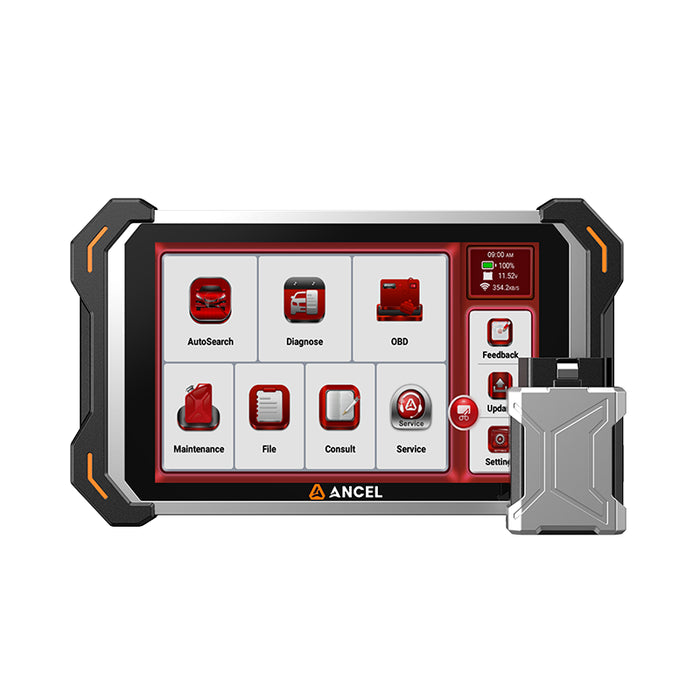
Diagnose BARO Sensor Problems with Live Data
View ANCEL DS600 BTWhat Should a Normal BARO Sensor Reading Be?

A normal BARO reading should be close to the actual atmospheric pressure at the vehicle’s current elevation. There is no single fixed “normal” value for every location.
Typical reference points:
| Elevation | Approximate Atmospheric Pressure |
|---|---|
| Sea level | 101.3 kPa / 14.7 psi / 29.92 inHg |
| 2,500 ft (760 m) | ~92 kPa / 13.3 psi / 27.2 inHg |
| 5,000 ft (1,520 m) | ~84 kPa / 12.2 psi / 24.8 inHg |
| 7,500 ft (2,290 m) | ~76 kPa / 11.0 psi / 22.4 inHg |
3 Quick Rules for Verifying Normal BARO Readings
- Match Your Altitude: Compare the BARO PID on your OBD2 scanner with the expected atmospheric pressure for your current elevation. The BARO value should make sense for the current elevation. A reading that is clearly inconsistent with local altitude and weather conditions should be investigated further.
- Compare BARO vs. MAP at KOEO: With Key On, Engine Off (KOEO), manifold pressure should be close to ambient atmospheric pressure. If BARO and MAP differ significantly, check both sensor readings, wiring, and vehicle-specific specifications before blaming the BARO sensor.
- Check Signal Voltage Against Service Specs: On analog BARO circuits, verify reference voltage, ground, and signal voltage with a multimeter. A signal stuck near ground or supply voltage may indicate a short, open circuit, wiring fault, or failed sensor. Use the manufacturer’s specified voltage range rather than one universal threshold.
Can You Drive With a Bad Barometric Pressure Sensor?
NO. You may be able to drive temporarily with a BARO sensor fault if the engine is running normally, but the problem should be diagnosed soon. Incorrect barometric-pressure data can affect engine-management calculations and may cause poor performance, increased fuel consumption, limp mode, or other drivability problems.
When Short-Term Driving May Be Possible
Short-distance driving may be reasonable if:
- The engine starts and idles normally
- There is no major power loss or severe hesitation
- No limp-mode warning is active
- The Check Engine Light is steady rather than flashing
- The vehicle is not being used for towing or heavy-load operation
When You Should Avoid Driving
Stop or limit driving if you notice:
- Severe loss of power
- Repeated misfires or rough running
- Hard starting
- Limp mode
- Significant hesitation under load
- Abnormal performance after large altitude changes
- Multiple pressure-related or air/fuel-related DTCs
These symptoms may indicate that the BARO fault is affecting other engine-management functions.
Extra Caution for Turbocharged and Heavy-Duty Vehicles
On turbocharged gasoline engines and heavy-duty diesel applications, BARO data may also be involved in boost, load, or emissions-related calculations. A faulty or implausible BARO signal can therefore cause stronger performance restrictions or protective strategies on some vehicles.
For commercial vehicles, towing, or mountain driving, it is safer to diagnose the fault before continuing under high load.
Barometric Pressure Sensor Replacement and Cost
Replacing a BARO sensor can be a relatively simple repair when the vehicle uses a standalone, accessible sensor. Cost and labor vary more when the BARO function is integrated into a MAP/MAF sensor, another module, or a heavy-duty diesel system.
Average Replacement Cost
There is no single universal BARO sensor replacement price. Total cost depends on the sensor design, vehicle, labor rate, and whether additional diagnosis or programming is required.
| Component / Service | Typical Cost Considerations |
|---|---|
| Standalone BARO Sensor | Usually the simplest and least expensive configuration |
| Integrated MAP/BARO Sensor | May require replacing a combined sensor assembly |
| Heavy-Duty Diesel BARO Sensor | Parts and labor may be higher depending on engine platform and access |
| Wiring / Connector Repair | Adds cost if corrosion, damaged terminals, or circuit faults are found |
| Programming / Relearn | Required only on some vehicles or replacement procedures |
When Should the BARO Sensor Be Replaced?
Replace the sensor only after diagnosis confirms that the sensor itself is the likely fault.
A replacement is more justified when:
- BARO live data is clearly implausible
- BARO-related DTCs return after testing
- Power, ground, wiring, and connectors check normally
- Related MAP or pressure data appears plausible
- Vehicle-specific testing points to the BARO sensor
Typical DIY Replacement Procedure
For a standalone BARO sensor, the general process may include:
-
Turn off the ignition and allow the engine to cool.
Disconnect the battery if required by the vehicle’s service procedure. -
Locate the sensor.
Confirm from service information whether the vehicle uses a dedicated BARO sensor or an integrated pressure sensor. -
Inspect the connector and wiring.
Check for corrosion, loose terminals, moisture, damaged wires, or poor connections before replacing the sensor. -
Disconnect the electrical connector.
Release the locking tab carefully to avoid damaging the connector. -
Remove the sensor.
Remove any retaining screws, bolts, clips, or seals according to the vehicle-specific procedure. -
Install the replacement sensor.
Use the supplied seal or O-ring where applicable, and tighten fasteners to the manufacturer’s specification. -
Reconnect the electrical system.
Reconnect the sensor connector and battery if it was disconnected. -
Clear DTCs and verify live data.
Use an OBD2 scanner to confirm that the BARO reading is plausible for the current altitude and atmospheric conditions.
Key Installation Tips
- Inspect the connector before replacing the sensor. Wiring faults can imitate a failed BARO sensor.
- Replace damaged seals or O-rings when specified. Reusing a worn seal can create air or pressure-related problems on some sensor designs.
- Do not overtighten plastic sensor mounts. Use the manufacturer’s torque specification rather than a universal value.
- Do not assume every vehicle needs a relearn. Perform an adaptation or relearn only when the service information requires it.
- Verify the repair with live data. A successful repair should restore a plausible BARO reading and prevent the related DTC from returning.
Before Paying for a Replacement
Confirm three things first:
- Does the vehicle actually use a separate BARO sensor?
- Is the problem the sensor itself, or the wiring / related pressure input?
- Does the replacement require calibration, relearn, or programming?
This helps avoid unnecessary parts replacement and keeps the repair focused on the actual cause of the BARO fault.


