


If your check engine light just came on and a scan reveals code P0133, you're dealing with one of the most common oxygen sensor faults on the road.
The good news: in most cases, it's not an emergency.
The less good news: the fix can range from a $20 vacuum hose to a $250 sensor, and figuring out which one applies to your car requires a bit of diagnostic work.
This guide walks through what the code actually means, why it happens, how it differs by vehicle make, and what it typically costs to resolve.
What Does the P0133 Code Mean?
P0133 stands for "O2 Sensor Circuit Slow Response (Bank 1, Sensor 1)."
In plain terms, your engine computer (the PCM) is watching how quickly the oxygen sensor's voltage output switches between "lean" and "rich" as it reads exhaust gas.
A healthy sensor should switch fairly quickly — often within a fraction of a second. When the switching takes longer than the PCM expects, it sets P0133.
Understanding "Bank 1" and "Sensor 1" — Engine Layout Basics
Bank 1
- Bank 1 refers to the side of the engine that contains cylinder #1.
- On inline (4- or 6-cylinder) engines, there's only one bank, so Bank 1 refers to the entire engine.
- On V6 and V8 engines, The engine has two cylinder banks, Bank 1 and Bank 2 are two separate cylinder banks, each with its own exhaust path and sensors. and Bank 1 identifies the side containing cylinder #1.
Sensor 1
- Sensor 1 means the oxygen sensor located before the catalytic converter.
- This is the sensor that directly influences fuel trim, so a slow response here has a more immediate impact on how the engine runs than a downstream sensor fault would.
- This sensor is also called:
Upstream oxygen sensor
Front O2 sensor
Air-fuel ratio sensor (on some vehicles)
Where Is the Bank 1 Sensor 1 Located?
Bank 1 Sensor 1 is threaded into the exhaust manifold or the exhaust pipe just after it, on the same side as the #1 cylinder. Practically speaking:
- On most inline 4-cylinder engines, there's just one exhaust manifold, so Bank 1 Sensor 1 is straightforward to find — it's the sensor closest to the engine block, before the catalytic converter.
- On V6 and V8 engines, you'll need to identify which side houses cylinder #1 first (check your vehicle's factory service manual or a repair database, since this varies by manufacturer). Once you know that, Sensor 1 on that side is your target.
- It's usually accessible from underneath the vehicle, though on some transverse-mounted V6 engines it can be tucked close to the firewall, making it a tighter job.
Also read: Where is O2 Sensor Bank 1 Sensor 2 Located? Clearly Explained
Why Does the Oxygen Sensor Response Speed Matter?
The ECM constantly adjusts fuel injection based on oxygen sensor feedback.
When the engine runs:
- Too much fuel = rich mixture
- Too little fuel = lean mixture
A healthy upstream oxygen sensor rapidly changes its signal as exhaust oxygen levels change.
When the sensor becomes slow:
- The ECM receives delayed information.
- Fuel adjustments become less accurate.
- The engine may run less efficiently.
This is why a slow oxygen sensor response can trigger the P0133 code.
Symptoms of the P0133 Code
P0133 doesn't always come with dramatic symptoms, which is part of why it often goes unnoticed until a scan tool catches it. Common signs include:
- Check engine light illuminated (steady, not usually flashing)
The vehicle’s ECM detects that the oxygen sensor response time is outside the expected range and stores the P0133 code.
- Reduced Fuel Economy
Since the PCM may default to a less efficient fuel trim strategy when sensor data is unreliable. Drivers may notice:
More frequent fuel stops
Lower MPG readings
Increased fuel consumption
Fuel economy often decreases gradually, making it difficult for drivers to notice until they compare fuel usage over several weeks.
- Rough or uneven idle
Occasional hesitation or slight power loss during acceleration
- Increased Exhaust Emissions
In some cases, a slight increase in exhaust odor or failed emissions test, since delayed sensor response can affect how tightly the air-fuel ratio is controlled
Many drivers report no noticeable symptoms at all beyond the warning light — the engine may run fine day to day while still logging the code.
Also read: Decoding Your Car's Check Engine Light
What Causes the P0133 Code?
-
Soot or Oil Contamination on the Sensor
Oxygen sensors are sensitive to physical contamination. Oil consumption (from worn piston rings or valve seals), excessive carbon buildup, or coolant leaking into the combustion chamber can coat the sensor tip, slowing its ability to react to changing exhaust gas composition. -
Sensor Reaching End of Service Life
Many oxygen sensors can last over 100,000 miles, but their response speed may gradually decrease as they age, and their switching speed naturally degrades over time even without an obvious failure or contamination event. If your vehicle is in that mileage range and none of the above causes check out, a simply aged sensor is a reasonable explanation.
-
Faulty Wiring
Corroded connectors, chafed wiring, or a loose ground connection in the sensor's circuit can introduce resistance or intermittent signal loss, which the PCM may interpret as a slow response. -
Leaking Vacuum or Intake Manifold Line
A vacuum leak introduces unmetered air into the intake system, throwing off the air-fuel ratio. The oxygen sensor accurately reports a genuinely irregular exhaust condition, but the PCM logs it as an abnormal sensor response. -
Incorrect Fuel Pressure
Fuel pressure that's too high or too low (often from a failing fuel pump or a clogged fuel filter) changes the actual air-fuel mixture reaching the cylinders, which can indirectly trigger this code even though the sensor itself is functioning correctly. -
Dirty or Malfunctioning Mass Air Flow (MAF) Sensor
Since the MAF sensor and O2 sensor work together to fine-tune fuel delivery, an inaccurate MAF reading can cause the engine to run rich or lean, indirectly showing up as a slow O2 sensor response.
P0133 Always Mean a Bad O2 Sensor?
NO. A common mistake is assuming:
- P0133 = Replace the oxygen sensor
However, P0133 is a sensor performance code, not necessarily a sensor failure code.
A failed oxygen sensor usually produces:
- No signal
- Incorrect voltage output
- Heater circuit problems
A slow-response sensor still produces a signal but reacts too slowly when the air-fuel mixture changes.
For this reason, proper diagnosis should confirm the cause before replacing any parts.
Real-World Example
A vehicle owner repeatedly experienced a P0133 code even after replacing the upstream oxygen sensor.
Further inspection revealed that engine oil leaking from the valve cover gasket had saturated the sensor wiring. After repairing the oil leak and replacing the contaminated sensor, fuel economy improved significantly, although continued monitoring was still necessary.
This illustrates an important point:
Replacing the oxygen sensor alone may not permanently solve P0133 if another engine problem is slowing the sensor's response.
Are P0133 Codes Common Across Different Vehicle Makes?
While the underlying definition of P0133 is standardized across all OBD-II platforms, how often it triggers—and what typically causes it—varies by manufacturer.
Because a P0133 is a general code, the core diagnostic sequence remains the same for all brands: confirm the code, check for related codes, inspect wiring/vacuum lines, and only replace the sensor once external factors are ruled out.
However, understanding manufacturer-specific patterns can significantly speed up your troubleshooting:
| Make | Commonly Reported Triggers | Notes |
|---|---|---|
| Ford | Aging upstream sensors, minor vacuum leaks on higher-mileage V6/V8 trucks and SUVs | On V-configuration engines, confirm which bank is "1" before ordering parts — Ford's bank numbering isn't always intuitive |
| Toyota | Sensor wear on higher-mileage 4-cylinder models, occasional wiring harness chafing near the exhaust manifold | Toyota sensors are generally durable, so a P0133 earlier than expected is worth checking for contamination first |
| Honda | Sensor degradation, and in some cases confusion between P0133 (Sensor 1) and P0139 (Sensor 2) faults | See the P0133 vs P0139 section below — this distinction matters more on Honda forums than most other brands |
| Nissan | Wiring connector corrosion, MAF sensor contamination affecting fuel trim | Check connector condition before replacing the sensor outright |
| Jeep / Dodge | Vacuum leaks around intake manifold gaskets, sensor wear on V6 engines | Shared platforms across Jeep and Dodge/Chrysler models mean similar root causes across several model years |
| Chevy | Oil consumption-related sensor contamination on some V6/V8 engines, aging sensors | If oil consumption is a known issue on your specific engine, check the sensor for oil fouling first |
Is It Safe to Drive With a P0133 Code?
Generally, yes — for the short term.
P0133 by itself typically won't leave you stranded, and it's not the kind of code associated with immediate engine damage.
In many cases, driving for a short period is possible if:
- The engine runs normally
- There is no severe misfire
- There is no overheating
- The check engine light is steady rather than flashing
Long-Term Driving
That said, driving on it for an extended period isn't ideal:
- Reduced fuel economy adds up over time
- An underlying cause left unaddressed (like a vacuum leak or contaminated sensor) can worsen and eventually affect the catalytic converter, which is a far more expensive repair
- If P0133 is accompanied by other codes, or by a flashing (not steady) check engine light, treat that as more urgent and have it looked at promptly
The practical takeaway
- A P0133 code usually indicates a diagnostic issue rather than an immediate emergency, but finding the actual cause helps avoid unnecessary repair costs.
- So get it diagnosed within a reasonable timeframe, but you generally don't need to pull over immediately.
P0133 vs P0139: What's the Difference?
These two codes get mixed up often, especially among Honda and Toyota owners searching for answers, because they involve the same general system. Here's the actual distinction:
| Code | Position | Location | Core Function | Impact on Performance |
| P0133 |
Bank 1, Sensor 1 |
Before the catalytic converter |
Direct role in fuel trim calculations |
More influence on performance & fuel economy |
| P0139 |
Bank 1, Sensor 2 |
After the catalytic converter |
Primarily monitors converter efficiency) |
Less impact on drivability |
Both codes share several possible causes — wiring issues, sensor contamination, and sensor aging chief among them — but because Sensor 1 has a more direct role in engine management, P0133 is generally considered the higher priority of the two to resolve.
How to Diagnose P0133 With an OBD2 Scanner
Step 1: Confirm the P0133 Code With an OBD2 Scanner
First, verify the stored trouble code.
A car diagnostic tool can show:
- Stored DTCs
- Freeze frame data
- Engine conditions when the code appeared
Freeze frame information is useful because it shows:
- Engine RPM
- Vehicle speed
- Coolant temperature
- Fuel system status
This helps determine whether the problem occurred during idle, acceleration, or normal driving.
Step 2: Check Live O2 Sensor Data
After confirming the P0133 code, the next step is checking the oxygen sensor’s actual performance.
A healthy upstream oxygen sensor should respond quickly as the engine switches between rich and lean conditions.
Using a diagnostic scanner with live data capability, technicians can monitor:
- O2 sensor voltage changes
- Fuel trim values
- Short-term fuel trim (STFT)
- Long-term fuel trim (LTFT)
If the sensor voltage changes too slowly compared with expected operating conditions, it supports the possibility of an oxygen sensor response issue.
However, slow switching does not always mean the sensor itself is defective.
For example:
- A vacuum leak may create a lean condition.
- A dirty MAF sensor may affect air measurement.
- Fuel delivery problems may change combustion conditions.
This is why live data analysis is important before replacing parts.
Step 3: Inspect Oxygen Sensor Wiring and Connections
Before replacing an oxygen sensor, inspect the electrical system.
Check for:
- Damaged wires near the exhaust manifold
- Melted insulation caused by heat exposure
- Corrosion inside connectors
- Loose sensor connections
Because oxygen sensors operate in a high-temperature environment, wiring damage is relatively common.
A wiring issue can create symptoms similar to a failing sensor while requiring a much simpler repair.
If the sensor connector or wiring is coated with engine oil, trace the source of the leak before installing a replacement sensor. Oil contamination may damage the sensor over time and cause the new part to fail again.
Step 4: Check for Vacuum Leaks and Air-Fuel Problems
If the oxygen sensor appears functional, investigate other causes that can affect air-fuel readings.
Common checks include:
Vacuum leak inspection
Look for:
- Cracked vacuum hoses
- Intake manifold leaks
- Loose intake connections
Fuel system inspection
Possible issues include:
- Low fuel pressure
- Injector problems
- Fuel delivery restrictions
MAF sensor inspection
A contaminated MAF sensor can incorrectly measure incoming air and cause improper fuel adjustments.
Step 5: Determine Whether the Oxygen Sensor Needs Replacement
After completing the previous checks, replacement may be necessary if:
- The sensor response remains slow
- Wiring is confirmed to be good
- No vacuum leaks are found
- Fuel and air systems are operating normally
Replacing the sensor should be the final step after confirming the diagnosis.
What Tools Can Help Diagnose and Clear P0133?
Many vehicle owners replace oxygen sensors immediately after seeing a P0133 code.
However, using an OBD2 scanner first can help determine whether the problem is actually caused by:
- The oxygen sensor itself
- Wiring problems
- Fuel mixture issues
- Other engine-related conditions
The right diagnostic tool depends on how deeply you want to investigate the problem. Here are two options:
For Basic Diagnosis: ANCEL AD410 OBD2 Scanner
An entry-level OBD-II scanner such as ANCEL AD410 can be a practical option.
It is suitable for drivers who want a simple way to identify common OBD-II issues without needing professional automotive scanner.
Typical uses include:
- Confirming the P0133 diagnostic trouble code
- Reading related engine fault codes
- Viewing freeze frame data
- Checking live engine data and O2 sensor test results
- Clearing codes after repairs
For many check engine light issues, the first step is identifying the stored trouble code and verifying whether additional engine data points to a sensor fault or another underlying problem.
For Advanced Diagnosis: ANCEL X7 Diagnostic Scanner
For users who want deeper analysis, a more advanced diagnostic scanner such as ANCEL X7 can provide additional information.
During P0133 diagnosis, advanced scanning functions can help monitor:
- Live oxygen sensor voltage
- Freeze frame data
- Engine operating parameters
- Real-time data streams
This data helps technicians determine whether the slow sensor response is more likely related to:
- An aging oxygen sensor
- An abnormal air-fuel mixture
- Fuel delivery issues
- Other engine conditions that require further inspection
By comparing live sensor data with actual engine operating conditions, technicians and experienced DIY users can avoid replacing the oxygen sensor before ruling out other possible causes.
Recommended Diagnostic Tools for P0133
Whether you simply want to read and clear a P0133 code or perform deeper live-data analysis, these ANCEL diagnostic tools can help you identify the root cause before replacing parts.

ANCEL AD410 PRO
Ideal for everyday drivers. Read and clear P0133 codes, view freeze frame data, monitor live data, perform O2 sensor tests, and check battery health.
View AD410 PRO →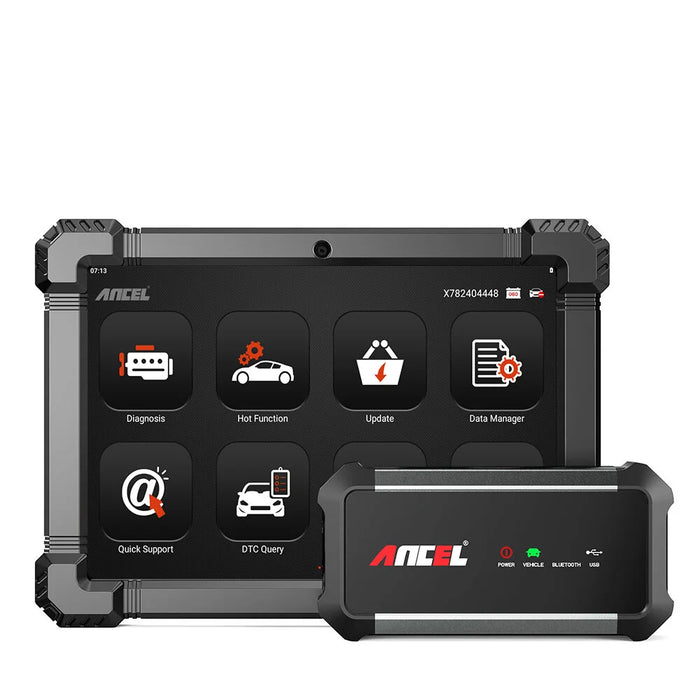
ANCEL X7
Designed for advanced diagnostics. Analyze live data streams, freeze frame data, and full-system information to troubleshoot P0133 more accurately.
View ANCEL X7 →How to Fix P0133
Once you've narrowed down the likely cause, here's the general repair path for each:
- Contaminated sensor: if the sensor itself is fouled from oil or carbon but structurally fine, cleaning rarely restores proper response time reliably — replacement is usually the practical fix.
- Wiring issues: repair or replace damaged wiring, clean and re-secure corroded connectors, and confirm a solid ground connection before assuming the sensor itself is bad.
- Vacuum leaks: locate the leak (a smoke test is the most reliable method) and replace the damaged hose, gasket, or intake component.
- Fuel pressure issues: test fuel pressure against factory specs; replace the fuel pump, filter, or pressure regulator as needed.
- MAF sensor problems: clean the MAF sensor with an appropriate MAF-safe cleaner first, and replace it only if cleaning doesn't resolve the readings.
- Aged sensor: if the vehicle is high-mileage and no other cause is found, replacing the O2 sensor is the standard resolution.
After any repair, clear the code and take a short drive cycle to confirm it doesn't return — some vehicles require several drive cycles before the PCM re-evaluates and turns off the check engine light.
How Much Does It Cost to Fix P0133?
| Repair Type | Typical Cost Range | Note |
| Diagnostic Scan | $50–$150 | Many professional repair shops charge this baseline diagnostic fee. |
| Oxygen Sensor Replacement | $150–$300 | labor makes up the rest, especially on vehicles where the sensor is hard to reach. |
| Wiring Repair | $100–$200 | Applies to connector or wiring harness repair, though costs can rise if a full harness section needs replacement. |
| Vacuum Leak Repair | $20–$200+ | Or $200+ if it involves an intake manifold gasket. |
| Fuel Pump or Pressure Regulator Replacement | $300–$600 | General cost range, since fuel pump access often requires more labor. |
| MAF Sensor Cleaning / Replacement | Under $20 – $250 | Under $20 for cleaner and a DIY job; professional replacement runs $80–$250 depending on the vehicle. |
Diagnosing the actual cause before replacing parts is the single best way to avoid unnecessary spending on this code — a $250 sensor replacement won't fix a $30 vacuum leak, and vice versa.
FAQ
Can a bad O2 sensor cause P0133?
Yes. A slow or aging upstream oxygen sensor is one of the most common causes of P0133.
However, other issues such as vacuum leaks, wiring problems, or fuel system problems can create the same code.
Is P0133 the same as P0139?
No.
- P0133 refers to the upstream sensor (Bank 1, Sensor 1), which directly affects fuel trim.
- P0139 refers to the downstream sensor (Bank 1, Sensor 2), which mainly monitors catalytic converter efficiency.
They share some causes but affect the vehicle differently, and P0133 is generally the higher priority to fix.
How do I fix P0133 without replacing the sensor?
The correct repair depends on the cause.
Possible solutions include:
- Repairing damaged wiring
- Fixing vacuum leaks
- Cleaning a dirty MAF sensor
- Correcting fuel system problems
- Replacing the oxygen sensor if it is confirmed faulty
What's the best tool to read and clear a P0133 code?
Any compatible OBD-II scanner can read and clear the P0133 trouble code.
Basic scanners such as ANCEL AD410 are suitable for checking and clearing codes, while advanced diagnostic scanners with live data functions such as the ANCEL X7 can help analyze oxygen sensor performance and fuel adjustments.
Why Does My P0133 Code Keep Coming Back After I Clear It?
Many drivers notice that clearing the code only turns the check engine light off temporarily.
If the underlying cause—such as an aging O2 sensor, vacuum leak, wiring issue, or oil contamination—has not been repaired, the PCM will usually detect the same slow-response condition during its next drive cycle and store P0133 again.
Can I Just Clear the Code and Keep Driving?
Yes, but only temporarily.
This is one of the most common questions drivers ask after seeing a P0133 code.
Clearing the P0133 code may turn off the check engine light, but it does not fix the underlying problem. If the oxygen sensor is still responding too slowly—or another issue such as a vacuum leak, damaged wiring, or sensor contamination remains unresolved—the engine control module (ECM) will usually detect the same condition during its next drive cycle, causing the P0133 code to return.
When is it generally safe to keep driving?
You can usually continue driving for a short period if:
- The engine runs normally.
- The check engine light is steady (not flashing).
- There are no severe symptoms such as misfires, overheating, or significant power loss.
- You're planning to diagnose or repair the problem as soon as possible.
When shouldn't you ignore the code?
Repeatedly clearing the code without identifying the root cause is not recommended. A slow oxygen sensor response can reduce fuel economy and increase exhaust emissions. Over time, the underlying issue may place additional stress on the catalytic converter, which is significantly more expensive to repair than an oxygen sensor, wiring repair, or a vacuum leak.
Bottom line
Clearing the code is only a temporary reset—not a repair. If the P0133 code returns after a drive cycle, the vehicle should be properly diagnosed to identify the actual cause before replacing parts.


